Every summer, families with children who have disabilities make a quiet calculation before VBS registration opens.
Will my child be welcomed here or just tolerated? Will I spend the whole week waiting for a phone call? Will my kid come home feeling like they didn’t quite fit?
Most VBS directors want to include every child. The gap between that intention and the actual experience of these families is almost never about bad hearts. It’s about preparation knowing what to ask, what to build, and what to change before the first child walks through the door.
This is for directors who want to close that gap.
Accommodation vs. Inclusion & The Difference Matters
There’s a distinction worth naming before anything else.
Accommodation means adjusting your existing program so a child with a disability can participate. Inclusion means designing your program so that participation was never in question.
Accommodation is reactive. Inclusion is structural.
A child who is accommodated knows it. They feel the adjustments happening around them the whispered conversations, the special setup, the extra adult hovering. Even when it’s done with genuine care, it rarely feels seamless.
A child who is included just… does VBS. With everyone else. In an environment built with them in mind.
That shift — from how do we handle this situation to how do we build a program where this was never a problem — is what separates programs that families recommend to each other from programs they quietly avoid.
Start With the Conversation, Not the Form
The most powerful inclusion tool you have is a well-designed registration process — and that means more than a health field on a form.
Forms create distance. A direct, warm conversation before VBS week communicates something a form never can: we actually want to know your child.
When a family registers a child with a disability, reach out personally. Keep it simple and curious, not clinical:
“We want to make sure [child’s name] has a great week. Can you tell us a little about how they do best in group settings? Are there things that tend to overwhelm them or things that help them settle in?”
That single conversation does three things. It gives you the information you need. It builds immediate trust with the parent. And it signals that your church is the kind of place that asks which is itself a form of welcome before VBS ever begins.
Document what you learn. Brief your station leaders before the week starts.
The Four Categories and What Each One Needs
Children who need support at VBS generally fall into four broad categories. Most real children overlap more than one. But the framework helps directors prepare.
Physical and Mobility Disabilities
Children who use wheelchairs, walkers, or crutches; children with limited stamina or chronic illness; children who experience pain or fatigue with prolonged activity.
What they need most: Stations and rotations designed at accessible heights. Seating options that don’t require extended floor-sitting. Pathways without steps, tight corridors, or uneven terrain. And critically permission to participate at whatever energy level they have that day, without explanation or apology.
The thing to audit before week one: Walk every rotation specifically as an accessibility check. Is the craft table height workable from a wheelchair? Is there a step that seems minor but becomes a real barrier at transition 3? Small physical details become large experiences when you’re the one navigating them.
What to avoid: Setting up “accessible” seating that visually separates a child from the group. That child isn’t included they’re adjacent to inclusion.
Sensory Processing Differences
Children who are overwhelmed by noise, crowds, light, textures, or movement or who seek intense sensory input. This category includes many children on the autism spectrum, children with sensory processing disorder, and children with ADHD-related sensitivities.
What they need most: A designated quiet space not a timeout room, a calm space any child can use voluntarily, without stigma. Visual schedules they can reference throughout the day. Advance warning before loud activities (worship, games, skits) so they can prepare or opt for reduced-intensity participation. Transition warnings: “We’re moving to the next station in five minutes.”
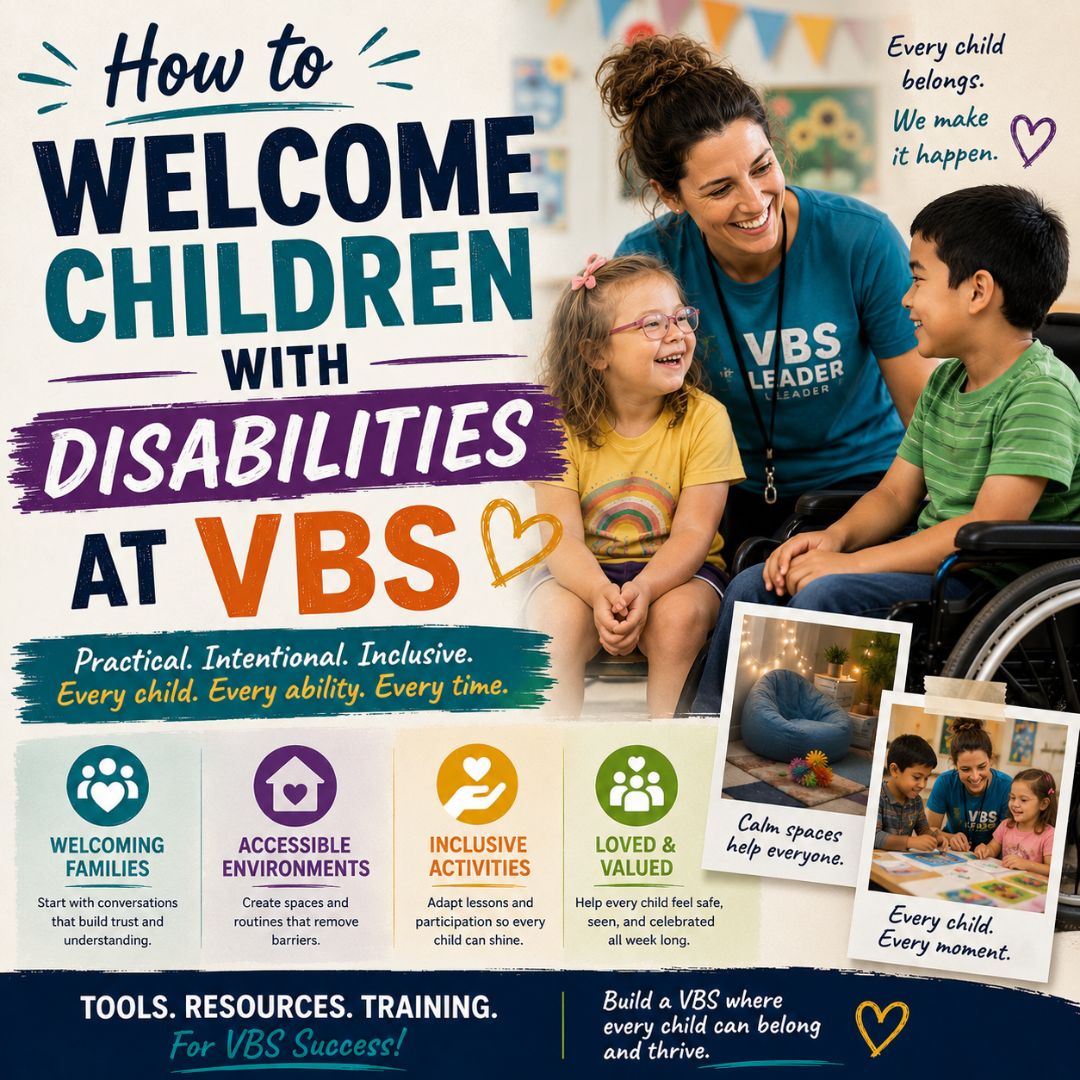
The quiet space deserves its own setup. A few chairs or cushions, dimmer lighting if possible, simple instructions posted on the wall. Make it feel like a resource, not a consequence.
What to avoid: Assuming a child covering their ears or stepping out is misbehaving. Treating the quiet space as something that can be taken away. And worth naming plainly VBS environments that are maximally loud and stimulating every single minute of every single day. That exhausts all children, not just those with sensory differences.
Cognitive and Intellectual Disabilities
Children with Down syndrome, intellectual disability, significant developmental delays, or traumatic brain injury. Processing speed, reading level, and comprehension may vary significantly from same-age peers.
What they need most: Simplified language in teaching moments — shorter sentences, concrete concepts, less abstraction. Visual reinforcement alongside verbal instruction. Extra processing time before responses are expected. Activities that allow participation at multiple levels simultaneously.
The thing directors miss most: Talking to the child’s buddy volunteer instead of the child. The child is there. Talk to them.
What to avoid: Making reading, writing, or abstract reasoning the only path to participation. And measuring a child’s spiritual engagement by whether they can articulate what they learned. A child who cannot recite the memory verse may have experienced something genuine and true in the worship room. Don’t let curriculum metrics become the only measure of a meaningful week.
Behavioral and Emotional Regulation Challenges
Children with ADHD, anxiety, PTSD, reactive attachment disorder, or trauma histories. This is often the hardest category for volunteers because the presenting behavior can look like defiance.
What they need most: Predictability — knowing what comes next reduces anxiety-driven behavior significantly. Relationship before correction — a child who knows one adult at VBS will regulate far better than a child surrounded by strangers. And de-escalation approaches that don’t involve public correction, removal, or shame.
The single highest-impact practice: Assign a “Day 1 connection adult” — one person whose specific job is to build a relationship with this child on the first day. That one relationship changes everything that follows.
What to avoid: Correction that happens in front of the group. Assuming a dysregulated child is choosing to be difficult. And the phone call to parents that ends with “you may want to come pick them up.” If a child is regularly sent home, the program has failed — not the child.
Your Buddy Volunteer System
For children who need one-on-one support, a buddy volunteer system is the most common and effective structure. A few design principles that change outcomes:
The buddy is not a handler. Their job is not to contain the child or manage behavior. Their job is to help the child participate in everything everyone else is participating in. The posture is with, not over.
Match intentionally. A high-energy child with ADHD paired with a quiet, easily-frustrated volunteer is a hard week for everyone. Think about fit, not just availability.
Train before the week. One focused hour covering what to expect, how to communicate with the child, what to do if the child becomes dysregulated, and who to call for backup changes outcomes significantly. A volunteer who shows up on Day 1 with no preparation will make well-intentioned mistakes.
Build in a backup. If a buddy volunteer calls out sick, a child who depends on that relationship may have a genuinely hard day. Have a plan before you need it.
Talking with Parents All Week
Parents of children with disabilities arrive carrying a combination of hope and protective caution. They want this to work. They’ve also been let down before.
Give a daily specific. Not “she did great” but “she was the first one to jump in during the Bible story today.” Thirty-second specific conversations at pickup build more trust than any printed welcome letter.
Report hard moments honestly, not catastrophically. “We found the worship room was a lot today tomorrow we’re going to offer the headphones earlier. He did really well once we made that adjustment.” That sentence tells a parent: we’re paying attention, we’re adapting, and your child is not a problem we’re managing.
Don’t call unless safety is genuinely at risk. That call communicates failure and makes families less likely to return next year. Exhaust your internal resources first.
Volunteer Training — What Actually Needs to Be Said
Inclusion doesn’t live in your director’s notebook. It lives in how your volunteers respond in the moment. A 45-minute training before week one should cover:
Behavior as communication. When a child is dysregulated, they are communicating that something is wrong — not choosing to ruin VBS. Train volunteers to ask what does this child need right now? rather than how do I stop this?
The quiet space. Every volunteer should know where it is, how to use it, and that any child can access it — not just children with disabilities.
How to get help. Who do volunteers go to? What’s the protocol? A volunteer who doesn’t know the answer to that question will freeze or escalate. Neither is good.
Permission to say “I don’t know.” A volunteer who says “I want to make sure I’m helping you the right way — let me get someone” is doing exactly the right thing. Normalize it.
Pre-Week Environment Checklist
Walk your facility specifically as an accessibility audit before VBS begins:
- All rotation paths wheelchair navigable with no steps or tight corridors
- Alternative seating available — no required extended floor-sitting
- Craft tables accessible from a seated position
- Quiet/calm space set up, stocked, and explained to all volunteers
- Visual schedules posted at child eye level
- At least one space with adjustable lighting
- Noise-reducing headphones available
- Sensory tools available (fidgets, lap weights if appropriate)
- Restroom accessibility assessed
- Emergency evacuation plan adapted for children with mobility needs
An Honest Word About Limitations
Most VBS programs don’t have dedicated special education staff. Most buddy volunteers aren’t trained therapists. Most directors are already running at capacity going into week one.
Inclusive VBS doesn’t require perfection. It requires honesty.
If a child’s needs exceed what your program can safely support, have that conversation with the family directly, early, and gently — not on Day 3 when things have already broken down. Describe what you can offer. Ask what adjustments might make participation possible. Bring the parents in as partners, not problems to manage.
Some families will appreciate the honesty. Some will be disappointed. But the families who return will know they’re in a place that tells the truth — and that is the foundation of every other kind of welcome.
What These Kids Actually Remember
A child with a disability who has a great VBS week doesn’t just remember the theme or the snack or the Bible verse.
They remember that they were there. With everyone else. That they weren’t pulled aside or managed separately or sent home. That someone knew their name on Day 1 and was genuinely glad to see them on Day 5.
That memory is worth every hour of preparation it takes to create it.
Every child deserves to leave VBS knowing they belong not as a special case, not as a ministry project, but as a full participant in something real.
That’s what welcome actually looks like.
FAQ
Should we ask on registration if a child has a disability? Yes framed as an invitation, not a screening. Try: “Is there anything about your child’s learning style, sensory needs, or health that would help us make their week great?” Follow up by phone whenever a family shares something significant.
What if a child’s needs are more than we can safely meet? Be honest early. Describe specifically what your program offers and where the limits are. That conversation handled with care is better for everyone than a week that damages trust on all sides.
Does every child with a disability need a buddy? No. Many children participate fully with minor environmental adjustments. The pre-registration conversation will help you identify who needs a one-on-one buddy and who simply needs a well-prepared environment.
What’s the single most important thing? Ask. Ask parents what their child needs. Ask the child what makes them comfortable. Ask volunteers what would help them serve better. Most inclusion failures happen not because churches refuse to help but because nobody asked.