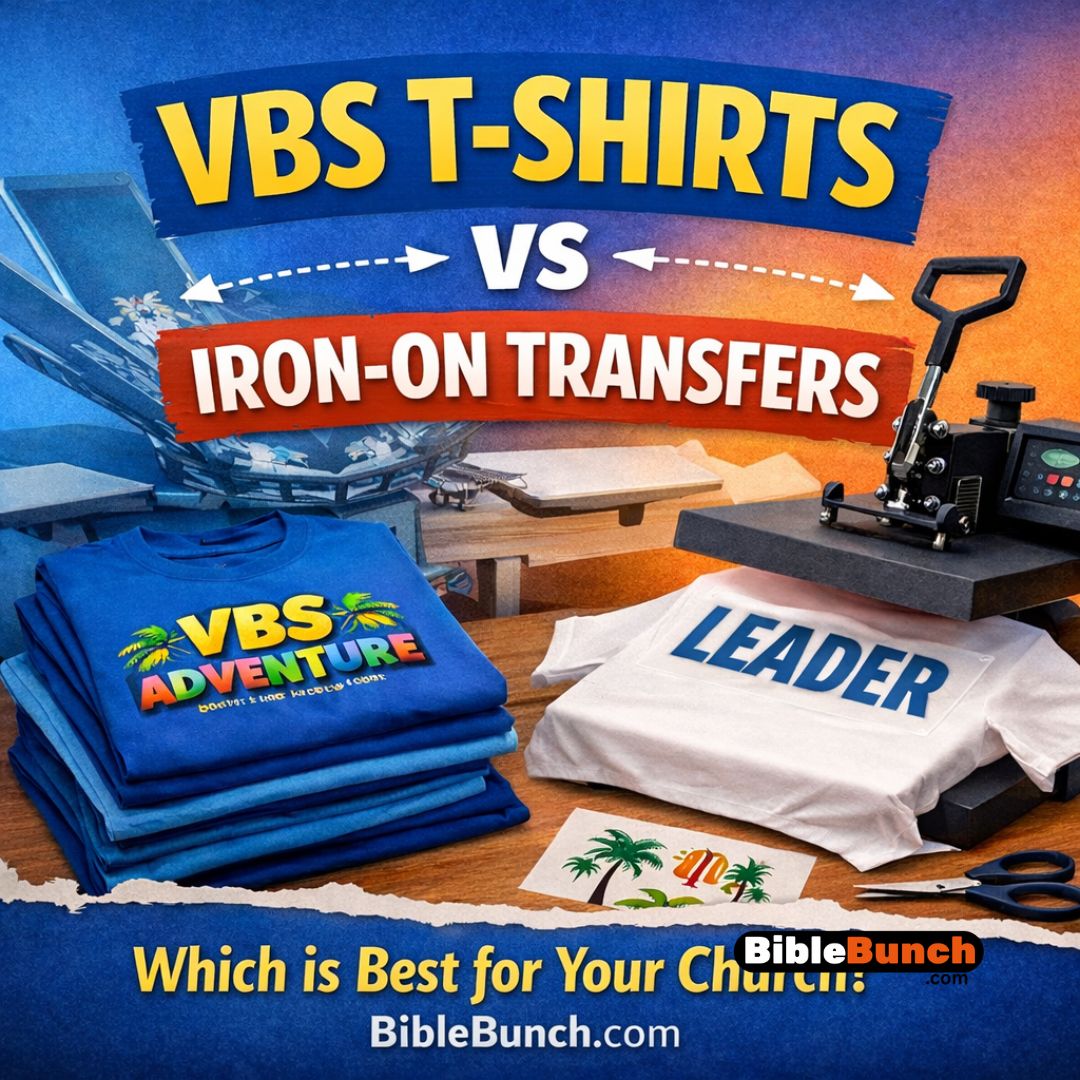
A Clear Comparison for Vacation Bible School Leaders
When churches begin planning Vacation Bible School, one small decision quickly becomes a surprisingly practical one:
Should we buy professionally printed VBS shirts — or make them ourselves using iron-on transfers?
Across North America, both approaches are common. Large programs often order bulk shirts from printers, while smaller churches sometimes rely on volunteers to create shirts using heat-transfer vinyl or printable iron-on sheets.
At first glance, the choice seems simple: buying shirts costs more, while DIY shirts appear cheaper.
But once factors like durability, volunteer time, order size, and equipment are considered, the calculation becomes more nuanced.
Below is a practical breakdown based on apparel printing industry practices and typical church event planning realities.
Side-by-Side Comparison
| Factor | Buying Printed VBS Shirts | Iron-On / Heat Transfer Shirts |
|---|---|---|
| Cost Per Shirt | Lower for large orders | Lower for very small orders |
| Best Order Size | 50–1000+ shirts | 1–40 shirts |
| Durability | High (screen-printed ink bonds into fabric) | Moderate (transfer sits on surface) |
| Print Quality | Professional and consistent | Depends on volunteer skill |
| Volunteer Time | Minimal | Significant |
| Equipment Needed | None | Heat press or iron |
| Customization | Limited after printing | Easy to personalize |
| Production Speed | 1–2 weeks typical | Same day possible |
| Risk of Errors | Very low | Moderate to high |
Buying Professionally Printed VBS Shirts
For churches running medium-to-large VBS programs, ordering professionally printed shirts is often the default choice.
Screen printing — the most common process — presses ink directly into the fibers of the fabric. This method produces shirts that typically withstand repeated washing and extended wear without cracking or peeling.
Professional printers also benefit from economies of scale. Once the design screens are created, each additional shirt costs relatively little to produce.
Typical pricing patterns look like this:
| Quantity | Estimated Cost Per Shirt |
|---|---|
| 25 shirts | $12–$18 |
| 100 shirts | $7–$10 |
| 500 shirts | $4–$7 |
For churches expecting dozens or hundreds of participants, bulk printing often becomes the most cost-efficient option.
There is another advantage frequently overlooked in planning meetings: time.
Ordering shirts removes a significant burden from volunteers. No cutting vinyl, aligning transfers, reheating presses, or correcting mistakes. Shirts simply arrive in boxes, ready to distribute.
The main drawbacks are largely logistical. Professional printers require advance ordering, artwork approval, and minimum quantities. Adding names or special roles usually increases the cost.
Making VBS Shirts with Iron-On Transfers
DIY shirts using iron-on transfers or heat-transfer vinyl offer flexibility that professional printing cannot always match.
Because the design is applied individually, churches can easily add personalized details such as:
- student names
- volunteer roles
- team numbers
- small design variations
Iron-on methods also eliminate setup costs. For small VBS programs needing only a handful of shirts, this can make DIY production attractive.
Another advantage is speed. If registrations increase at the last minute, shirts can be produced quickly without waiting for a printer’s turnaround schedule.
However, the trade-off becomes clear once production begins.
Each shirt must be prepared individually — cutting vinyl, removing excess material, aligning the design, and applying heat for the correct duration. A moderately detailed design can take 15 to 20 minutes per shirt.
For a VBS program with 80 volunteers and leaders, that process can quickly turn into 15 hours of work or more.
Durability can also be an issue. Unlike screen printing, iron-on transfers sit on top of the fabric. Over time, repeated washing can cause cracking or peeling, particularly if the transfer was not applied at the exact temperature and pressure required.
Mistakes are also common. Slightly crooked placement or overheating the transfer can ruin the shirt entirely.
Finally, equipment matters. While household irons can work, consistent results typically require a heat press, cutting machine, and weeding tools — equipment many churches do not already own.
A Realistic Cost Example
Consider a church preparing 80 shirts for volunteers and leaders.
| Method | Estimated Cost |
|---|---|
| Professional printing | $560–$720 total |
| DIY iron-on materials | $320–$480 total |
| Volunteer labor required | Approximately 15 hours |
While the DIY approach may save money on materials, the difference often narrows when volunteer time is factored in.
When Each Option Works Best
Buying Printed Shirts Makes Sense When:
- Your VBS expects 50 or more participants
- You want consistent, professional results
- Volunteers already have full workloads
- Durability matters
DIY Iron-On Shirts Work Best When:
- You need fewer than 30 shirts
- You want personalized names or roles
- You enjoy craft-style preparation
- You need shirts produced quickly
The Hybrid Approach Many Churches Use
Some churches combine both methods to balance cost and flexibility.
A common strategy looks like this:
| Group | Shirt Strategy |
|---|---|
| Kids | Professionally printed shirts |
| Volunteers | DIY iron-on names or titles |
| Team leaders | Customized shirts |
This approach preserves the professional appearance of the main shirts while allowing personalization for leadership roles.
The Decision Most VBS Leaders Eventually Make
After years of planning VBS programs, many leaders discover the decision is not purely financial.
It becomes a question of where volunteer energy is best spent.
Is it worth saving a few dollars per shirt if volunteers must spend hours cutting vinyl and pressing transfers?
Or would those hours be better used preparing crafts, teaching Bible lessons, or welcoming families?
As one experienced VBS coordinator put it:
“The year we stopped making our own shirts was the year our volunteers actually had time to enjoy the week.”
In the end, the best option is the one that serves the mission of VBS — helping kids encounter the love of Christ — while keeping volunteers energized rather than exhausted.