
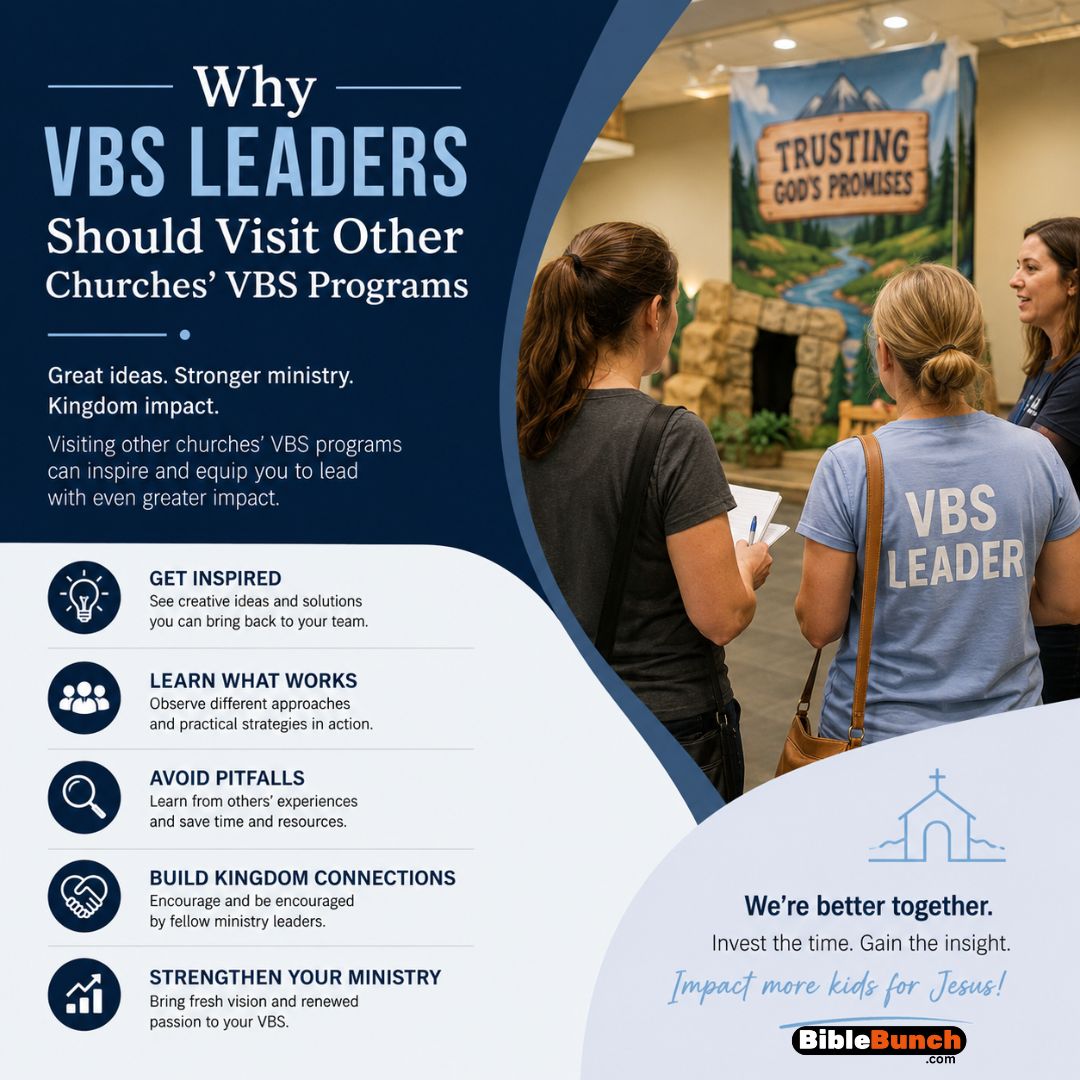
A simple piece of advice showed up on Facebook recently: go visit other VBS programs in your city.
For a tired VBS director, that may sound like one more item on a list that is already too long. You are already thinking about registration, snacks, crafts, Bible lessons, decorations, safety, volunteers, check-in, music, name tags, parent questions, and the dozen details that seem to appear only after the week begins.
Still, that advice is worth taking seriously.
Visiting another church’s Vacation Bible School is not about comparison. It is not about copying another ministry or deciding whose decorations, attendance, or budget look better. It is about remembering that God is working in more places than one building, and that VBS leaders are stronger when they learn from one another.
A short visit to another church’s VBS can give you practical ideas, fresh encouragement, useful ministry relationships, and a wider view of what God is doing among children and families in your own community.
You See What Actually Works
VBS leaders spend months dealing with ideas. Curriculum ideas. Decoration ideas. Rotation ideas. Snack ideas. Volunteer ideas. Some look promising in a planning meeting but fall apart once children are moving through the hallways.
That is why it helps to see another VBS in motion.
You may notice how a church welcomes families at the door. You may see a cleaner way to arrange registration tables, a better flow for moving children between stations, or a simpler approach to signs and hallway directions. You may watch a Bible story teacher hold the attention of a room without expensive props. You may see volunteers wearing shirts or badges that make it easy for parents to know who can answer questions.
Often the best ideas are not dramatic. They are small, practical decisions that reduce confusion.
A church may have a simple name tag system that keeps allergy notes visible. Another may have a snack process that avoids bottlenecks. Another may use one clearly marked parent pickup entrance instead of letting families wander through the building. Another may have discovered that a shorter opening rally helps younger children stay engaged.
Those details matter. They are the difference between a VBS that feels frantic and one that feels prepared. If your own team is still wrestling with basic flow, signups, check-in, or parent communication, it may also be worth comparing those observations with a stronger VBS registration system for kids and volunteers.
Good VBS leaders are not threatened by good ideas. They are grateful for them. One thoughtful visit can solve a problem your team has been overthinking for weeks.
You Remember That You Are Not Alone
VBS is joyful work, but it is demanding work.
Directors carry pressure that is often invisible to the rest of the church. They recruit volunteers, answer parent questions, adjust schedules, track supplies, manage last-minute cancellations, prepare leaders, calm anxious children, and keep the week moving when something breaks, runs out, or goes missing.
Much of that work happens before anyone sees the stage decorations or hears the first song.
Visiting another VBS reminds you that other churches are carrying the same kind of burden. Their volunteers are showing up after work too. Their teenagers are learning how to help younger children too. Their directors are watching the clock, answering questions, and praying that the gospel is clear too.
That kind of encouragement matters.
Scripture tells the church, “Therefore encourage one another and build one another up” (1 Thessalonians 5:11, ESV). Sometimes that encouragement comes through a note, a text, or a Sunday morning thank-you. Sometimes it comes by standing in another church hallway and seeing faithful people serving children with patience and joy.
VBS leaders need that reminder. The work is local, but it is not isolated. If visiting another church shows you that your own helpers need clearer expectations, better onboarding, or a calmer pre-week meeting, VBS volunteer training is a natural next place to strengthen your own team.
You Learn to Celebrate Instead of Compare
Some leaders hesitate to visit other churches because they know comparison will be tempting.
What if their decorations are better? What if they have more children? What if their volunteer team is larger? What if their stage looks polished and yours looks simple? What if they seem to have the budget, space, and staff your church does not?
Those thoughts are understandable, but they are not spiritually healthy places to stay.
If another church is reaching children with the gospel, that is not a threat. It is a reason to give thanks. If children across town are singing about Jesus, hearing Scripture, being welcomed by adults, and learning that church is a place where they are seen and loved, that is Kingdom work.
Paul writes, “Let each of you look not only to his own interests, but also to the interests of others” (Philippians 2:4, ESV). For VBS leaders, that means learning to care about more than our own numbers, our own schedule, and our own week.
A healthy church can rejoice when another church bears fruit. A healthy VBS leader can look at another congregation’s creativity, generosity, and faithfulness without resentment.
The goal is not for every church to run VBS the same way. The goal is for churches to become more faithful in their own place, with their own people, using the resources God has given them.
You May Find Supplies, Decorations, and Shared Wisdom
There is also a very practical reason to visit nearby VBS programs: churches can help each other.
VBS takes supplies. Churches collect craft materials, build props, paint signs, organize decorations, buy snacks, create backdrops, print forms, and prepare volunteer materials. Then the week ends, and much of it goes into storage.
That does not have to be the end of its usefulness.
One church may have decorations another church can borrow. Another may have extra craft supplies. Another may have a backdrop, a registration checklist, a volunteer training handout, or a parent email template that would save someone else hours of work. One director may know which craft was too complicated, which snack worked well, or which arrival process caused confusion.
These are not small gifts, especially for smaller churches.
Not every congregation has a large children’s ministry budget. Not every church has storage space, a deep volunteer bench, or someone with design experience. When VBS leaders know one another, resources can move where they are needed instead of sitting unused. For churches trying to plan wisely before they spend, a VBS cost calculator can help directors think through supplies, fees, and budget conversations before the pressure hits.
That kind of sharing reflects the generosity Scripture commends in the church. Acts describes believers as being “of one heart and soul” and holding their possessions with open hands for the good of others (Acts 4:32, ESV). While VBS supplies are a small matter compared with the life of the early church, the principle still applies. Churches do not have to hold every resource tightly.
Sometimes a box of decorations, a borrowed sign, or a shared checklist can become a real encouragement to another ministry.
You Might Gain a Ministry Friend
One of the most valuable outcomes of visiting another VBS may not be an idea or a supply bin. It may be a person.
VBS directors understand things other people may miss. They know what it feels like to wonder whether enough volunteers will show up. They know the pressure of keeping children safe. They know the joy of hearing kids sing loudly about Jesus. They know how quickly a carefully planned schedule can change. They know the exhaustion that comes after the closing program, when everyone else goes home and the director is still thinking about follow-up, cleanup, and next year.
A simple visit can become a conversation. A conversation can become encouragement. Encouragement can become prayer. Prayer can become friendship.
That friendship may continue long after VBS week ends. You may begin checking in with each other before registration opens. You may trade supply lists, compare volunteer training plans, or pray for each other’s teams. You may meet after VBS to talk honestly about what worked, what failed, and what you would change.
For a director who often feels alone, that kind of relationship can be a gift.
The strongest VBS resource in your town may not be a curriculum box or a decoration closet. It may be another faithful leader who understands the work.
You Come Back with Fresh Eyes
When you have stared at your own VBS plan for months, familiar problems become hard to see.
You may not notice that signs are confusing until you see another church’s clean hallway setup. You may not realize your opening rally is trying to do too much until you watch a simpler one work better. You may not see that parents need clearer instructions until you experience another church’s check-in process as a visitor.
A visit gives you enough distance to see your own ministry more clearly.
You may come home with better questions. How can we make our welcome warmer? How can we make check-in easier? How can we reduce hallway confusion? How can we support volunteers before the week begins? How can we make the Bible lesson more memorable? How can we communicate with parents more clearly?
Those questions are not criticism. They are leadership.
The goal is not to become another church. The goal is to return to your own church with sharper judgment, renewed humility, and a few practical improvements that serve children and families well. If another church’s theme, Bible story flow, or schedule sparks better planning conversations, the VBS Curriculum Selector can help your team think through curriculum fit before committing to a direction.
Go as an Encourager, Not a Critic
When you visit another VBS, go with the right spirit.
Do not walk in as an inspector. Do not collect flaws. Do not return to your own team with gossip about what another church did poorly. Every VBS has weak spots. Every director is making decisions under pressure. Every church has limits that visitors may not understand.
Go to learn, but also go to bless.
Tell the director something specific that encouraged you. Thank a volunteer. Notice the care behind the work. Ask thoughtful questions when the timing is appropriate. Offer to share supplies or ideas from your own church if they would be helpful.
A short word of encouragement can mean more than you realize. Many VBS leaders hear about the problems first: the missing form, the allergy concern, the late pickup, the room change, the volunteer cancellation. A sincere thank-you from someone who understands the work can strengthen a tired leader.
Make It Part of Your VBS Rhythm
Visiting another church’s VBS does not need to be complicated. Choose one nearby church. Attend one opening or closing session. Walk through the public areas. Observe how families are welcomed. Notice the flow, signage, volunteer communication, and overall tone. Then follow up afterward with a brief note of thanks.
Over time, this can become part of a healthier local ministry culture. Churches can stop functioning as isolated VBS islands and begin acting like neighbors who want one another to flourish.
That kind of connection will not solve every VBS challenge. It will not recruit every volunteer, fix every budget, or make every planning problem disappear. But it can make the work less lonely and more generous.
VBS is not a competition between churches. It is a shared mission to help children hear about Jesus, be loved by His people, and see the church as a place where they are welcomed.
That is worth leaving your own building to see.