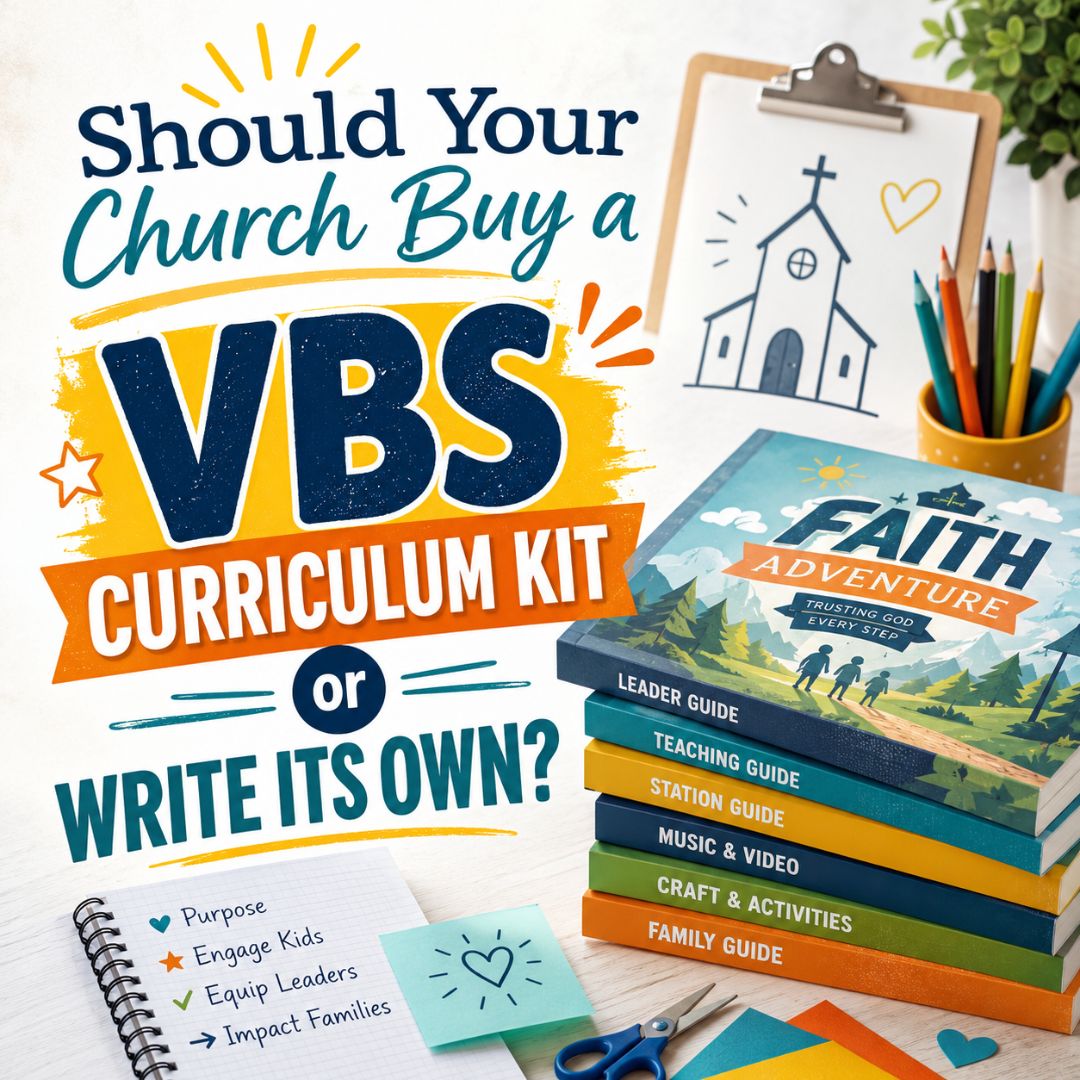
Every VBS season, the same conversation shows up in church offices, hallway meetings, and late-night planning texts. Should the church buy a Vacation Bible School curriculum kit, or should the team build something on its own?
The question usually starts with the budget. A director prices the curriculum, then adds music, decorations, crafts, snacks, printing, shirts, volunteer training, registration materials, and promotion. Before long, someone asks whether a church really has to spend that much money to teach children about Jesus.
That is a fair question. Many churches are doing faithful children’s ministry with small budgets and tired volunteers. They are not trying to cut corners. They are trying to be careful with the money they have.
Still, the cost of the kit is not the only cost in the room. If the church does not buy curriculum, someone still has to create the lessons, organize the schedule, prepare the leaders, gather supplies, write parent communication, and keep the week from becoming a scramble. The work does not disappear. It moves onto the backs of the people already carrying VBS.
That is why the better question is not only, “Can we afford this?” It is also, “What will this decision require from our people?”
A good VBS curriculum kit is not merely a theme with a few Bible stories attached. At its best, it gives a church a working plan: Bible lessons, daily teaching points, leader guides, music, opening and closing helps, crafts, games, promotional graphics, volunteer instructions, and age-level adjustments. Not every church will use every piece. Not every publisher’s kit will fit every congregation. Wise leaders still need to review the theology, simplify the schedule, and adapt the material for their own children and volunteers.
But the main value of a kit is that it gives the team a shared starting place.
That matters because VBS is usually led by ordinary church members. Some are strong teachers. Some are teenagers helping for the first time. Some love children deeply but would not know where to begin if handed a blank lesson plan. A curriculum kit gives those volunteers something steady to work from.
If your team is still comparing options, BibleBunch’s VBS Curriculum Selector can help you think through curriculum fit before you commit to a theme, publisher, or teaching approach.
A Kit Can Protect the People Doing the Work
Churches often talk about stewardship in terms of dollars, and they should. Budgets matter. But time is also stewardship. So is the emotional energy of the VBS director. So is the patience of the volunteer who agreed to teach but did not agree to write a full children’s curriculum from scratch.
When a church skips curriculum, the work has to be rebuilt somewhere. Someone writes the lessons. Someone checks the theology. Someone figures out whether the preschool class and the older elementary class can use the same story. Someone makes slides, supply lists, craft instructions, game plans, parent emails, volunteer notes, and follow-up reminders.
In many churches, all of that lands on one capable person. Because that person is capable, everyone assumes the plan is working. What they may not see is the hidden cost: late nights, rushed preparation, and a director who arrives at VBS already worn down.
Buying curriculum will not solve every problem, but it can reduce unnecessary strain. It can give nervous volunteers confidence. It can keep Bible time, crafts, games, music, and take-home pieces moving in the same direction. It can remove dozens of small decisions that otherwise pile up in the final weeks before VBS.
The curriculum should not run the church’s ministry. Leaders still need to pray, review, adapt, train, and care for families. But a good kit can keep the week from depending on one person’s ability to improvise under pressure.
If your church is already feeling the volunteer pressure, pair curriculum planning with clear team preparation. BibleBunch’s VBS Volunteer Training is a natural next step for churches that want helpers to understand expectations, safety, communication, and their role in the week.
When Writing Your Own VBS Actually Makes Sense
Some churches should write their own VBS.
A church may have strong teachers, artists, musicians, writers, and children’s ministry leaders who can build a simple, biblically serious program from the ground up. A pastor may want the week to reinforce a particular teaching emphasis. A small congregation may be hosting a backyard Bible club, a one-day outreach, or a short summer discipleship event that does not need a full commercial kit. Another church may have its own discipleship language and want VBS to fit more closely with the rest of its ministry.
There is nothing second-rate about that. In some settings, a homemade VBS may be the stronger choice.
It can also force a planning team to begin in the right place. Instead of starting with a theme and finding Bible passages to support it, the team can start with Scripture, the children in front of them, the volunteers they actually have, and the families they are trying to serve.
That kind of work can produce a beautiful week.
The problem comes when a church says it is writing its own VBS but is really trying to recreate a publisher’s work without paying for it. A church can write its own Bible lessons. The Bible is not owned by a curriculum company. Churches are free to teach Creation, Exodus, the miracles of Jesus, the parables, the cross, the resurrection, Acts, the fruit of the Spirit, the armor of God, and any other biblical theme.
What a church should not do is copy a publisher’s specific expression: the theme language, scripts, artwork, songs, videos, logos, mascots, handouts, activity structure, or lesson wording. Those pieces represent the labor of writers, designers, musicians, editors, and ministry teams.
This is not only a legal concern. It is a question of Christian integrity. If someone created a resource to serve churches, the church should not take that work while avoiding the cost attached to it.
Copyright Is Not a Side Issue
Churches sometimes assume that because the work is ministry, copying rules are different. That assumption can get a church into trouble.
Before using any curriculum, song, video, image, script, or downloadable file, read the permission statement. Look for what may be copied, what may be projected, what may be posted online, what may be printed, and what may be used only by the purchasing church. If the language is unclear, ask the publisher before using it.
This is not legal advice. It is a plain ministry caution. Do not guess with someone else’s creative work.
There is no shame in saying, “We cannot afford the full package.” Many churches are in that position. But it is a different thing to say, “Tell us the theme, lessons, and activities so we can rebuild it without buying it.” That is not thrift. It is taking what belongs to someone else.
Buy the Core, Simplify the Rest
A church with a small VBS budget does not have to choose between overspending and copying. In many cases, the best path is to buy the core curriculum and simplify everything else.
You may not need the full decoration package. You may not need a large stage set. You may not need themed snacks every night, custom shirts, photo booths, extra merchandise, or every optional craft kit. Many churches can buy the main teaching resources, leader guides, and essential media, then use simple supplies for the rest.
That keeps the focus where it belongs: clear Bible teaching and prepared leaders.
If your leadership team is trying to decide what you can actually afford, use the VBS Cost Calculator before the budget conversation turns into guesswork. A clear estimate helps churches separate essential ministry costs from extras that mostly add pressure.
For most churches, the priority order should be simple. Spend money where it helps children hear Scripture clearly. Spend money where it helps volunteers serve responsibly. Spend money where it helps parents receive accurate information. Simplify the parts that exist mainly for atmosphere.
Decorations can be simple. Snacks can be simple. Crafts can be simple. The teaching should not be thrown together because the adults were too overwhelmed to prepare.
Curriculum Is Not the Only System VBS Needs
A church can buy a strong curriculum and still create chaos if the rest of the week is poorly organized.
Families need to know where to go. Volunteers need rosters. Leaders need emergency contacts, allergy notes, medical details, pickup information, and class assignments. Someone needs to know which children are coming, which adults are serving, and what information must be available before the first child walks through the door.
That is why curriculum planning and registration planning belong together. The teaching plan and the administrative plan should support the same goal: a week that is safe, clear, welcoming, and centered on the gospel.
If your VBS registration still depends on paper forms, hallway conversations, and scattered spreadsheets, BibleBunch’s VBS Registration Pro gives churches one place to manage kids, volunteers, parent communication, payments, and exports. It is not a replacement for curriculum, but it helps remove the administrative fog that can distract leaders from ministry.
When a Full Kit Is More Than You Need
There are times when a commercial VBS kit may be too much for the moment.
A church plant hosting a small neighborhood Bible club may not need a full rotation model. A rural church with a handful of children may choose a simple three-night Bible series. A congregation with qualified teachers and writers may build its own material under pastoral oversight. A church may also reuse legally permitted resources from a previous year, as long as it follows the publisher’s license.
The important thing is to be honest about the work.
Who will write the lessons? Who will review the theology? Who will adapt the material for different ages? Who will build the supply list? Who will train volunteers? Who will write parent emails? Who will prepare follow-up? Who will make sure the youngest children and the oldest children are not being taught in the same way?
If the answer is one already-tired director, the free plan is not really free.
Sometimes the cheapest VBS plan is the one that costs your volunteers the most.
Questions to Ask Before You Decide
Before deciding whether to buy or build your VBS, gather the pastor, children’s ministry leader, VBS director, and a few key volunteers. Talk plainly about the decision.
Do we have qualified people with enough time to write biblically faithful, age-appropriate lessons? Do our volunteers need ready-made teaching helps to serve with confidence? Are we tempted to borrow a publisher’s theme, structure, artwork, songs, or activities without permission? Would buying the core kit reduce pressure on the team? Can we simplify decorations and extras instead of skipping curriculum? Have we read the permissions for every resource we plan to use? What plan will help children hear the gospel clearly and help volunteers serve without being crushed by the process?
Those questions will usually reveal the path forward.
The right choice will not be the same for every church. A large church may need the full kit and every rotation guide. A small church may only need the starter kit and a simpler schedule. A church plant may write a modest Bible club from scratch. A rural church may share costs with another congregation. A mid-sized church may buy the main program and keep decorations modest.
The goal is not to make your VBS look like someone else’s. The goal is to make it faithful, legal, sustainable, and kind to the people who have to carry it.