It is 7:38 on a Monday morning. A volunteer pulls a shirt out of a gallon Ziploc bag at the check-in table. The fabric is stiff. The collar is loose before it touches her neck. The cotton-poly blend will trap heat by 9 a.m. She tugs it on over her tank top, smiles at the director, and walks to her station.
That shirt is the first thing she touched at your VBS this year. It is the thing she will wear in every photo on your website for the next twelve months. And in six weeks, it will be a garage rag.
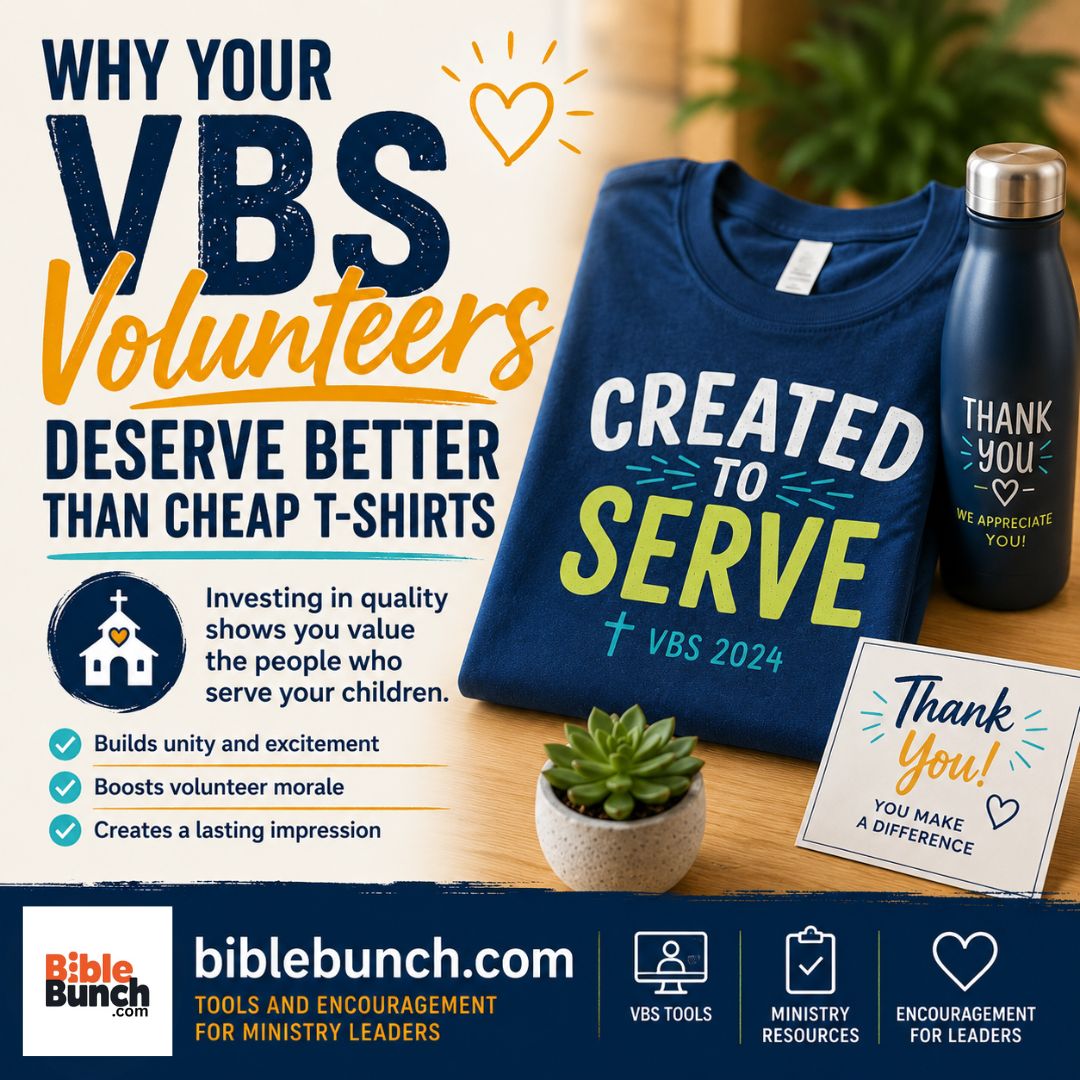
Most churches think of VBS volunteer shirts as a line item. They are actually a leadership document. A cheap shirt says one thing. A good one says something else entirely. The volunteer reads the message immediately, whether the church meant to write it or not.
“Most churches have their VBS budget upside down. They spend $3,000 on inflatables and $4 on the people running them. That is not stewardship. That is misalignment.”
What does a cheap shirt actually communicate to a volunteer?
A cheap shirt tells a volunteer the same thing a half-set table tells a dinner guest: we did not really prepare for you. The fabric, fit, and feel of a shirt is the first physical signal a volunteer receives on day one. Long before the worship rally or the closing prayer, the shirt has already told them where they sit on the church’s priority list.
Volunteers know. They have worn enough mass-printed shirts to recognize the difference between something a church chose and something a church ordered. The stiff Gildan 5000 with the cracked plastisol print, ordered six days late from the lowest bid on a quote site, communicates exactly what it was: the cheapest option that was technically available.
That is not stewardship. That is the line item nobody fought for.
Compare it to the volunteer who pulls on a soft, well-fitted ringspun cotton tee in a color the church actually thought about, with a print that will still look right after five washes. Same fifteen-second motion. Completely different message. “We expected you. We picked this with you in mind. We are glad you are here.”
You cannot say that out loud at the check-in table. The shirt says it for you.
How much should a church actually spend on volunteer shirts?
For most VBS programs, the cost difference between a forgettable shirt and a quality one is modest per person but significant in what it communicates. Compared to what the same church will spend on a single rented inflatable, photo backdrop, or stage prop, the math is not close.
Directors get nervous about per-unit cost because they are mentally multiplying. A cheap shirt times 40 volunteers feels manageable. A quality shirt times 40 feels like a fight with the finance team. So they pick the cheap shirt and quietly write a different number — the human cost — in pencil somewhere no one can read.
Run the math the other direction. What does it cost when a volunteer doesn’t come back next year? Most churches lose 20% to 30% of their VBS volunteers year over year. Recruiting a new one takes hours of phone calls, awkward asks, and the slow social tax of leaning on people who already feel leaned on. A modest shirt upgrade across the whole team is cheaper than recruiting two replacements.
The VBS Cost Calculator is useful here for a reason most directors miss. It is not just for budgeting forward. It is for budgeting honestly — for seeing where the dollars actually went last year and asking whether the priorities on paper match the values on paper.
For VBS Directors
Shop Quality VBS Volunteer Shirt Designs
Coordinated VBS shirt designs built for actual church teams — cohesive, theme-aligned, and easy to hand to your printer. No clip art. No filler.
Browse the BibleBunch Etsy Shop →Should volunteers and kids get the same shirt treatment?
No. They are doing different things. Volunteer shirts should be a quality investment because volunteers are giving the church a week of labor, emotional energy, and often unpaid time off. Children’s shirts should be optional — families who want them can buy them, families who can’t aren’t pressured. Treating both groups identically pretends the categories are the same. They are not.
This is the single most clarifying move a VBS director can make in their apparel budget. Stop pretending volunteer shirts and kids’ shirts are one line item. They are not.
Free shirts for every child get expensive fast, especially for larger programs, and the financial pressure usually pushes the whole order downmarket — including the volunteer shirts that didn’t need to be there. Pull them apart. Make kids’ shirts optional and purchasable. Let families opt in. Let the volunteer line item breathe.
The volunteer category is where the investment goes. These are the adults walking children to bathrooms, calming the kid who is crying because mom dropped him off in tears too, painting twenty-seven sets of plaster handprints, vacuuming up melted popsicle stains, and singing the same five songs eight times. They earned the better shirt. They earned it by being there.
A good volunteer shirt does not have to be expensive to be intentional. It has to be chosen.
What do quality VBS volunteer shirts actually look like?
A quality volunteer shirt fits well across body types, uses a softer fabric like ringspun or tri-blend cotton, prints with a method that survives multiple washes (water-based ink or DTG over thick plastisol), comes in a color that photographs well in mixed lighting, and arrives early enough to swap sizes before Monday morning. None of those choices require a luxury budget. They require a decision-making volunteer apparel coordinator who is not buying on autopilot.
A few things worth being specific about, because most directors have never been told them:
Fabric
Fabric weight matters less than fabric type. A 4.3 oz ringspun cotton will feel dramatically better than a 5.5 oz basic tee, even though it weighs less. Volunteers spend the week moving, sweating, and bending — they need a shirt that breathes.
Print Method
Print method matters more than logo design. A beautiful logo printed in heavy plastisol cracks and fades within ten washes. The same logo in water-based ink looks better forever. Ask your printer which method they use before you commit to a vendor.
Color
Color matters for photos. Bright safety-orange and neon yellow look great in person and terrible in your recap video. Mid-saturation colors — heather navy, sage, dusty teal, warm charcoal — photograph well in church gyms with mixed fluorescent and LED lighting, which is most of your photo conditions.
Sizing
Sizing matters for return. Order a size run that actually fits your team. Women’s-cut shirts for women who want them. A genuine XXL and XXXL count, not three of each as an afterthought. Volunteers who get a shirt that fits will wear it again. Volunteers who get a shirt that doesn’t, won’t.
Why does the volunteer shirt keep showing up in retention conversations?
Because retention is built from small repeated signals, not grand gestures. The shirt is the first signal of the week and the most durable one after it ends. Volunteers who feel prepared-for on Monday morning are more likely to be there next year. The shirt is rarely the deciding factor on its own — but it is almost always part of the story when a returning volunteer explains why they came back.
The deeper conversation here is not really about apparel. It is about whether your VBS culture has any line items that exist purely to honor the people doing the work — or whether every dollar is justified by what the children will experience.
Both matter. But a culture that only spends on the visible kid-facing experience is a culture that will burn out its adults inside three years.
A few low-cost moves that pair well with a good shirt: a printed welcome card on each volunteer’s chair Monday morning. A real lunch on Wednesday, not the leftover snacks from kids’ rotation. A handwritten thank-you note from the director the week after VBS ends. None of these are expensive. All of them tell the same story the shirt is already telling.
Resources like the 30-day volunteer recruitment timeline and the VBS Volunteer Training hub are downstream of the same conviction: when you invest in volunteers visibly and early, you stop running emergency recruitment drives in June.
Frequently Asked Questions
How much should we budget per volunteer shirt?
Quality varies widely, but the honest answer is: more than most churches currently budget, and less than most directors fear. A thoughtfully chosen volunteer shirt — softer fabric, durable print, sized well — will cost more than a basic promotional tee, and it should. The goal is a shirt the volunteer will still be wearing six months later, not one that becomes a garage rag before the recap service ends.
Should we charge volunteers for their shirts?
No. Volunteers are already giving the church a week of unpaid labor. Asking them to pay for the shirt that identifies them as staff sends exactly the wrong message. If budget is tight, reduce the kids’ shirt giveaway, simplify decor, or cut a line item somewhere else first.
What about offering kids’ shirts as an optional purchase?
This works well. Families who want matching shirts for photos and souvenirs can buy them; families who can’t or don’t want to spend extra are not pressured. It also separates kids’ apparel from your volunteer apparel line, which is the single most clarifying budget move a director can make.
Can a small church really afford quality volunteer shirts?
Yes, especially because the volunteer team at a small church is usually under 20 people. The total upgrade cost from forgettable shirts to good ones at that scale is often less than churches assume — and far less than the cost of one rented inflatable for a day.
Where do we find good VBS volunteer shirt designs?
This depends on whether you want a generic theme tee or something specific to your church and curriculum year. I design and sell VBS-themed shirt designs at the BibleBunch Etsy shop for churches that want coordinated apparel without commissioning custom work. Custom designs from a local designer or church member also work well if you have the lead time.
A note on the side of the table I’m sitting on
I design and sell VBS shirt designs on Etsy. I am writing this article knowing it overlaps with my own work. That is worth saying out loud, because you should always know which side of the table a writer is sitting on.
Here is what that side of the table has taught me: the churches who ask for the absolute cheapest shirt every year are not actually saving money. They are paying the same cost in volunteer turnover, in last-minute size scrambles, in shirts that fall apart before Sunday’s recap service. The dollars don’t disappear. They just move into harder-to-see categories.
The churches who treat volunteer apparel as a small, intentional investment — not a luxury, just a decision — are the ones who keep their teams. They are the ones who don’t run emergency recruitment drives in May. They are the ones whose volunteers show up to register the following year before the email even goes out.
A VBS shirt is not the gospel. It is not the curriculum. It is not the children hearing Scripture, which is the whole point of the week.
But details communicate values. And the shirt is one of the first details a volunteer touches.
A good one says, every year, the same three things:
We prepared for you.
We appreciate you.
We are glad you are here.
That is worth more than $4.
Ready to Order Volunteer Shirts?
Start with a Design Your Team Will Actually Want to Wear
Browse the BibleBunch Etsy shop for VBS volunteer shirt designs built specifically for church teams. Coordinated themes. Print-ready files. No clip art, no filler, no last-minute scramble.
Shop BibleBunch on Etsy →BibleBunch.com · etsy.com/shop/BibleBunch