Every VBS planning team eventually has to answer a question that sounds simple until the details begin piling up: what grades should we include?
That decision affects nearly everything else. It shapes how many volunteers you need, which rooms you use, how secure your check-in process must be, whether your curriculum fits the children in the room, and how tired your team will feel by the end of the week.
For most churches, the strongest VBS structure is clear: make Kindergarten through 5th grade the core program, add preschool only if your church can support it well, and invite 6th grade and older students into helper or leadership roles.
That model will not fit every church perfectly. A large church with a strong early childhood team may be ready for preschool. A smaller church may serve children better by keeping the program focused on elementary ages. The goal is not to copy another church’s structure. The goal is to choose an age range your church can serve safely, joyfully, and consistently.
The Best Default VBS Age Range
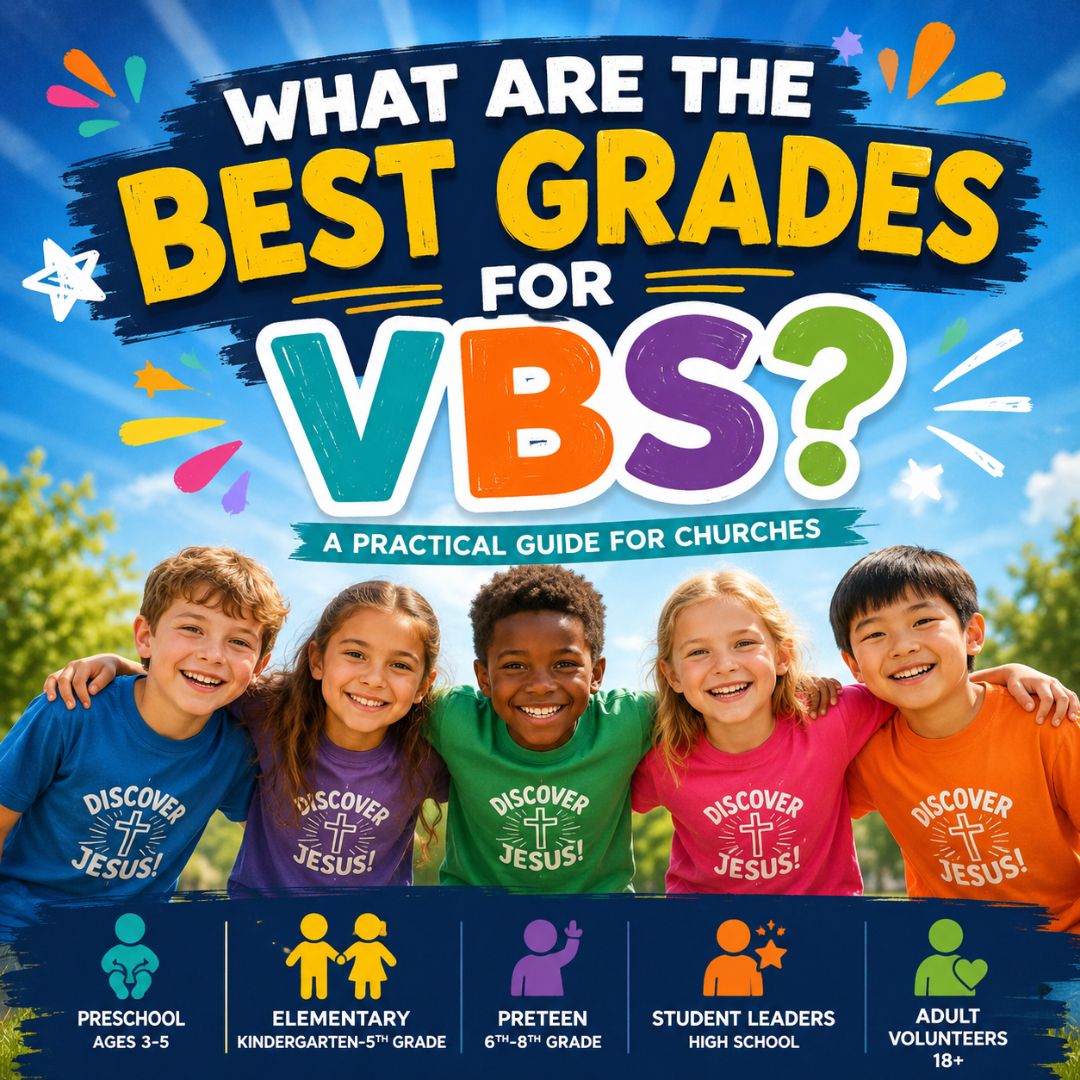
A healthy VBS structure often looks like this:
| Group | Recommended Role |
|---|---|
| Preschool | Optional, ages 3–5 |
| Core VBS Program | Kindergarten–5th Grade |
| Preteens | 6th–8th Grade helpers or special track |
| High School Students | Student leaders |
| Adults | Teachers, crew leaders, safety, registration, and support |
Kindergarten through 5th grade works well because elementary children are old enough to follow a schedule, move through rotations, participate in group teaching, and understand the basic rhythm of the week. They are also young enough to enjoy themed rooms, motions, games, crafts, skits, and the kind of joyful repetition that makes VBS memorable.
A common classroom structure is Kindergarten–1st grade, 2nd–3rd grade, and 4th–5th grade. That keeps developmental gaps manageable without forcing the church to staff a separate room for every grade. Younger elementary students usually need more help with transitions and instructions. Older elementary students can handle more discussion, responsibility, and independence. Keeping those groups close in age makes teaching easier and helps children feel comfortable with their peers.
This is also where curriculum planning becomes practical. Before your church finalizes grade levels, it helps to compare the curriculum you are considering with the children you expect to serve. The VBS Curriculum Selector can help directors think through theme, age fit, teaching approach, and overall program structure before registration opens.
Should Your Church Include Preschool in VBS?
Preschool can be a wonderful part of VBS, especially for churches trying to build trust with young families. A parent who brings a three-year-old or four-year-old to VBS is often watching carefully. They want to know whether your church handles safety, kindness, communication, bathroom needs, and pick-up with care.
The mistake is treating preschool as if it is just one more classroom.
Preschool VBS is a different ministry environment. Younger children need closer supervision, shorter activities, bathroom support, calmer transitions, simpler lessons, secure check-in and check-out, and volunteers who understand early childhood behavior. A preschool room cannot simply receive leftover supplies and whoever happened to volunteer late.
Before adding preschool, ask one serious question: can we do this safely and well?
If the answer is yes, preschool may become one of the most meaningful parts of your VBS. If the answer is no, it is better to focus on elementary students than to stretch your team past wisdom. Parents would rather see a church set clear limits than watch it overpromise and scramble.
For churches including preschool, safety planning should not wait until the week of VBS. Clear policies around check-in, release procedures, restroom help, allergies, incident reporting, and volunteer expectations protect both children and leaders. The VBS Child Safety Protection Policy Template is a helpful next step for churches that need written procedures before inviting younger children into the program.
For smaller churches, limiting VBS to Kindergarten through 5th grade is not a failure. It may be the most responsible choice. A focused, peaceful, well-led VBS is better than an oversized program held together by tired volunteers and hallway improvisation.
What Should You Do With 6th Graders and Middle Schoolers?
Sixth grade is often the hardest line to draw.
A rising 6th grader may still enjoy VBS songs and games, but may also feel too old for the younger children’s activities. A 7th or 8th grader may not be ready for full adult responsibility, but may be ready to help with games, snacks, tech, worship motions, decorations, photography, registration, or guiding younger children through rotations.
That is why many churches do better when they stop asking whether middle schoolers should “attend” VBS and start asking what kind of ownership they can be given.
Preteens often rise when trusted with meaningful responsibility. They need clear expectations, visible adult supervision, and specific jobs. They should not be treated as free labor or placed in charge of children without support. But when a middle school student is given a role that matters, VBS can become more than an event they outgrew. It can become an early step into service.
A 6th grader who helps lead motions, a 7th grader who assists at games, or an 8th grader who welcomes younger children at check-in may experience VBS differently. They are no longer only receiving ministry. They are learning to serve.
This is where volunteer planning matters. Student helpers need training just like adult volunteers do. They need to know who they report to, what they are allowed to do, what they should not handle alone, and how to respond when a younger child needs help. The VBS Volunteer Training resource can help churches prepare both adults and student helpers with clearer expectations before the week begins.
For churches with enough volunteers, a preteen track can also work well. That might include a separate Bible study, service projects, leadership training, or a shorter daily schedule. The challenge is staffing. A weak preteen track can feel like an afterthought. A well-led helper model is often more sustainable.
How Church Size Should Shape the Decision
A small church does not need to imitate a large church’s VBS structure. Social media can make VBS look like a competition in stage design, lighting, decorations, and crowd size. That comparison is rarely helpful.
Children remember being welcomed. They remember the leader who learned their name. They remember the teenager who sat beside them during music. They remember whether the room felt safe and whether adults seemed glad they were there. Those things matter more than elaborate sets.
A small church with 20 children, eight reliable volunteers, simple decorations, and thoughtful leadership can host a meaningful VBS. The structure may need to be leaner, but lean does not mean lesser.
For churches under 50 children, Kindergarten through 5th grade is often the cleanest structure. Combine nearby grades, keep the schedule shorter, and be careful about adding preschool unless there is a dependable early childhood team.
For churches with 50 to 150 children, it usually makes sense to separate elementary students into younger, middle, and older groups. Preschool may be possible with enough trained volunteers. Student helpers can add real strength if they are assigned clearly and supervised well.
For churches with more than 150 children, stronger systems become essential. Preschool should have its own team and space. Preteens may need a leadership track or defined helper system. Check-in, check-out, allergy information, emergency contacts, volunteer placement, and parent communication should be planned before registration opens.
The larger the VBS, the less a church can rely on memory and hallway conversations.
Questions to Answer Before Opening Registration
Before choosing your grade range, gather your actual volunteer numbers. Not hopeful numbers. Not people who “might be able to help.” Count the people who have clearly committed.
If your team is still short on leaders, decide that before expanding the age range. Adding preschool, preteens, or extra classrooms without enough trained help will create pressure in the places where children most need calm and consistent leadership. The 30-day volunteer recruitment timeline for VBS can help your team move from general announcements to a clearer plan for asking, assigning, and confirming volunteers.
Then look at your facility. A church may have enough enthusiasm for preschool but not enough secure rooms. Another church may have room for older students but no one prepared to lead them. The right grade range should match the people, space, safety systems, and curriculum your church actually has.
Ask whether your VBS is primarily outreach, discipleship, or both. An outreach-heavy VBS may prioritize simple registration, parent communication, and a welcoming structure for families who do not attend your church. A discipleship-focused VBS may lean more heavily into Bible teaching, small group relationships, and leadership development for older students. Most churches want both, but naming the priority helps you make better decisions.
Also ask what your church naturally does well. Some churches are especially strong with preschool families. Others have gifted elementary teachers. Others have a youth group ready to serve. A wise VBS structure builds from strength rather than guilt.
Final Recommendation
For most churches, the best VBS grade range is Kindergarten through 5th grade as the main program, preschool as an optional add-on, and 6th grade and up as helpers or student leaders.
That structure protects the heart of VBS without overwhelming the church. It gives elementary children an age-appropriate experience. It allows preschool to be added only when safety and staffing are strong. It gives older students a path into service instead of leaving them stuck between childhood and leadership.
A sustainable VBS matters because exhausted volunteers rarely return with joy the next year. Choose the grade range your church can serve well, then build a week where children are known, leaders are prepared, parents are confident, and the gospel is taught with care.
If your VBS team is ready to move from age-range decisions into registration, volunteer signups, parent communication, payments, and exports, VBS Registration Pro gives your church one place to manage the details without rebuilding the system every year.